
To Be an Author in Panorama: The Journal of Travel, Place, and Nature
December 1, 2025

The rule of three suggests that items, events, and plot points grouped into threes tickle the brain in a more satisfying way than singles, repetitions of twos, or needlessly longer series. With that being said, today marks my third appearance in Panorama: The Journal of Travel, Place, and Nature— a journal whose very title suggests an affinity with the rule of three. I’m no numerologist (and I hope you aren’t either), but I must confess my infatuation with the number three. Like many writers, I find that threes work their way into my prose over and over again. And now it seems, threes have worked their way into my publication history too.
But I digress. For this Winter 2025 issue on the topic of Encounters, I’ve published a personal essay disguised as a book review. “To Be an Author” is ostensibly a review of Frank Dax’s book Real Toads, Imagined Garden, but the review is mixed with my own story of meeting Frank and learning the power of the written word. If you want to know what it means to be an author, I suggest you give it a read. And if the “male loneliness epidemic” is something that concerns you, look to this essay for one way to end it. What I’m saying is, real men learn to write, and then they publish their prose to make friends.
More importantly, I cannot recommend Real Toads, Imagined Garden enough. It’s an absolutely fantastic read. If you have even a passing interest in everyday life in Korea, let Frank’s book be your guide.
I’ve posted a short traditional review below, but make sure to check out the Panorama publication for a more detailed look at my experience with the book.
Review of Real Toads, Imagined Garden
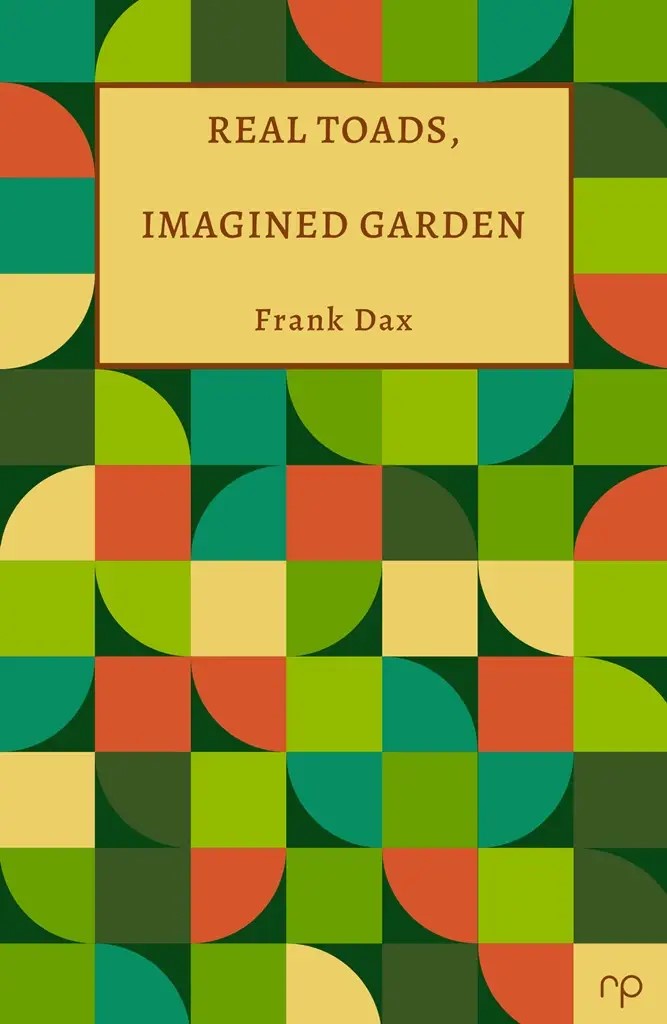
In a series of vignettes based in Korea, Frank Dax illustrates the relationship between the world he inhabits and the mind which seemingly constructs it, giving meaning to the everyday experiences of an outsider who looks upon the world to make sense of what lies within.
If there were only one word with which to describe the experience of reading Real Toads, Imagined Garden, it would be within the meaning of the noun sonder: a term which refers to the understanding that every stranger has a life as full and real as one’s own. Put another way, Dax’s book illustrates the roundness of every character, suggesting that none is any flatter than another. If you’ve ever had the empathy to realize that your thoughts are not yours alone, then you’ll tune right into the frequency of this book and understand what it means to be another.
Dealing with the profundity of this topic is no easy task, but to aid the approach Dax leans into poetic prose, taking inspiration from an earlier age when the romantics ruled the literary landscape. Real Toads, Imagined Garden wears this age-old sensibility on its sleeve, adorning each chapter with an epigraph in praise of Thoreau or Tolstoy or some other timeless voice. In like manner, Dax’s prose exists outside the era in which it was written, resisting modernity by habitating the liminal space between generations, between worlds, and (invoking the term sonder) between minds.
In like manner, the mise-en-scène of this book is distinctly Korean, but Dax’s more specific choice of location (an older neighborhood) and his focus on detail (the minutiae of brickwork, for example) will have you wondering whether the book references the 2020s or the 1820s. The effect works in tandem with Dax’s subject to suggest that a city like Seoul is a melting pot of not only people but also time. The Seoul that Dax walks through is inhabited by generations of peoples sweeping in and out of contact with one another’s lives, leaving imprints visible only to a literary archaeologist such as Frank Dax.
I’ll leave you with this quote from the book which acts as a measure of the emotional weight on display. “I came to understand that in this world I was simply a sojourner. And life — life was but a rented house.” p. 129
And of you read my essay, and then my review, and perhaps purchased a copy of Dax’s book, you should also check out three more essays published in the Encounters issue of Panorama. I think you’ll like Sybil Baker’s essay “Ulleung Island.” The essay is a nostalgic ride through a Korea that has almost disappeared. Another essay I think you’ll enjoy is Tia Welch Maerz’s “My Dinner with Hiro.” Read it to experience a slice of Japan. And finally, following on from the rule of three, I’d like to share one more essay. Shelly Moxley’s “The Carnivore of Eden” is an intriguing account of the Venus flytrap. There are many other great stories on Panorama, but the three above are some of my favorite and I think you’ll enjoy each one.